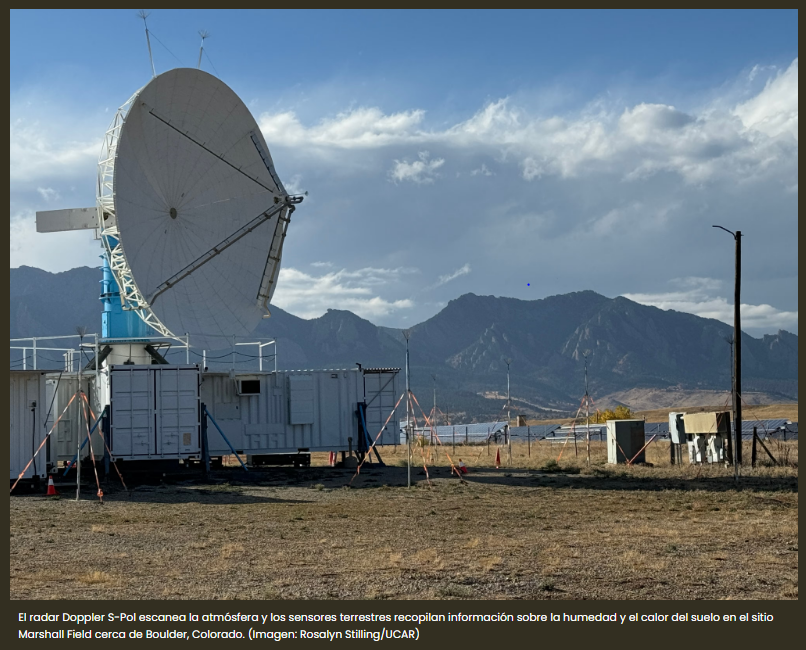
Un águila calva posada en un poste de teléfono supervisa una variedad de instrumentos atmosféricos esparcidos por el laboratorio al aire libre conocido como Marshall Field Site, ubicado en las afueras de Boulder, Colorado. Las torres de flujo de metal se elevan hacia el cielo. Los cables que las anclan al suelo se tensan contra el viento, lo que permite que la torre se mantenga firme y recopile información sobre el viento y los gases de efecto invernadero.
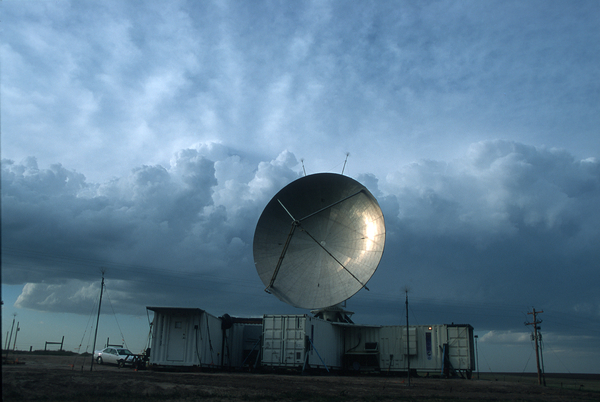
The S-Pol radar is a portable Doppler radar developed at the National Center for Atmospheric Research for use by NCAR and university scientists. It was used at the Severe Thunderstorm Electrification and Precipitation Study (STEPS), a field program held on the High Plains of the central United States in 2000.
En el año 2000 viajé al Centro de Investigaciones Atmosféricas de los EE.UU. como científico visitante. La historia que voy a contar ocurrió un 29 de junio del año 2000. Yo había llegado la noche antes a los EE.UU. y salimos bien temprano para el lugar donde estaba emplazado el radar S-Pol (en el pie de la figura están descritas sus características) para efectuar su trabajo en el estudio llamado STEPS (en el pie de figura se explica también lo que es). El radar estaba emplazado en medio de la nada, en un campo de maíz, a más de 600 km de Boulder, Colorado, que es donde radica el Centro Nacional de Investigaciones Atmosféricas (NCAR, mis lectores pueden leer de mis despistes en este lugar). El camino vecinal para llegar donde estaba emplazado el radar era estrecho, no pavimentado, sin embargo tenía todas la señales de tránsito que suele haber en cualquier carretera (curva a la derecha, curva a la izquierda, no tirar basura por la ventanilla…etc.). Bueno amables lectores, me desvío, que no es de tránsito ni de caminos de lo que quiero hablar. Ustedes saben que lo mío son los radares meteorológicos. (más…)
Cookie Consent
We use cookies to improve your experience on our site. By using our site, you consent to cookies.
Used to monitor number of Google Analytics server requests
10 minutes
__utmb
Used to distinguish new sessions and visits. This cookie is set when the GA.js javascript library is loaded and there is no existing __utmb cookie. The cookie is updated every time data is sent to the Google Analytics server.
30 minutes after last activity
__utmc
Used only with old Urchin versions of Google Analytics and not with GA.js. Was used to distinguish between new sessions and visits at the end of a session.
End of session (browser)
__utmz
Contains information about the traffic source or campaign that directed user to the website. The cookie is set when the GA.js javascript is loaded and updated when data is sent to the Google Anaytics server
6 months after last activity
__utmv
Contains custom information set by the web developer via the _setCustomVar method in Google Analytics. This cookie is updated every time new data is sent to the Google Analytics server.
2 years after last activity
__utmx
Used to determine whether a user is included in an A / B or Multivariate test.
18 months
_ga
ID used to identify users
2 years
_gali
Used by Google Analytics to determine which links on a page are being clicked
30 seconds
_ga_
ID used to identify users
2 years
_gid
ID used to identify users for 24 hours after last activity
24 hours
_gat
Used to monitor number of Google Analytics server requests when using Google Tag Manager
1 minute
_gac_
Contains information related to marketing campaigns of the user. These are shared with Google AdWords / Google Ads when the Google Ads and Google Analytics accounts are linked together.