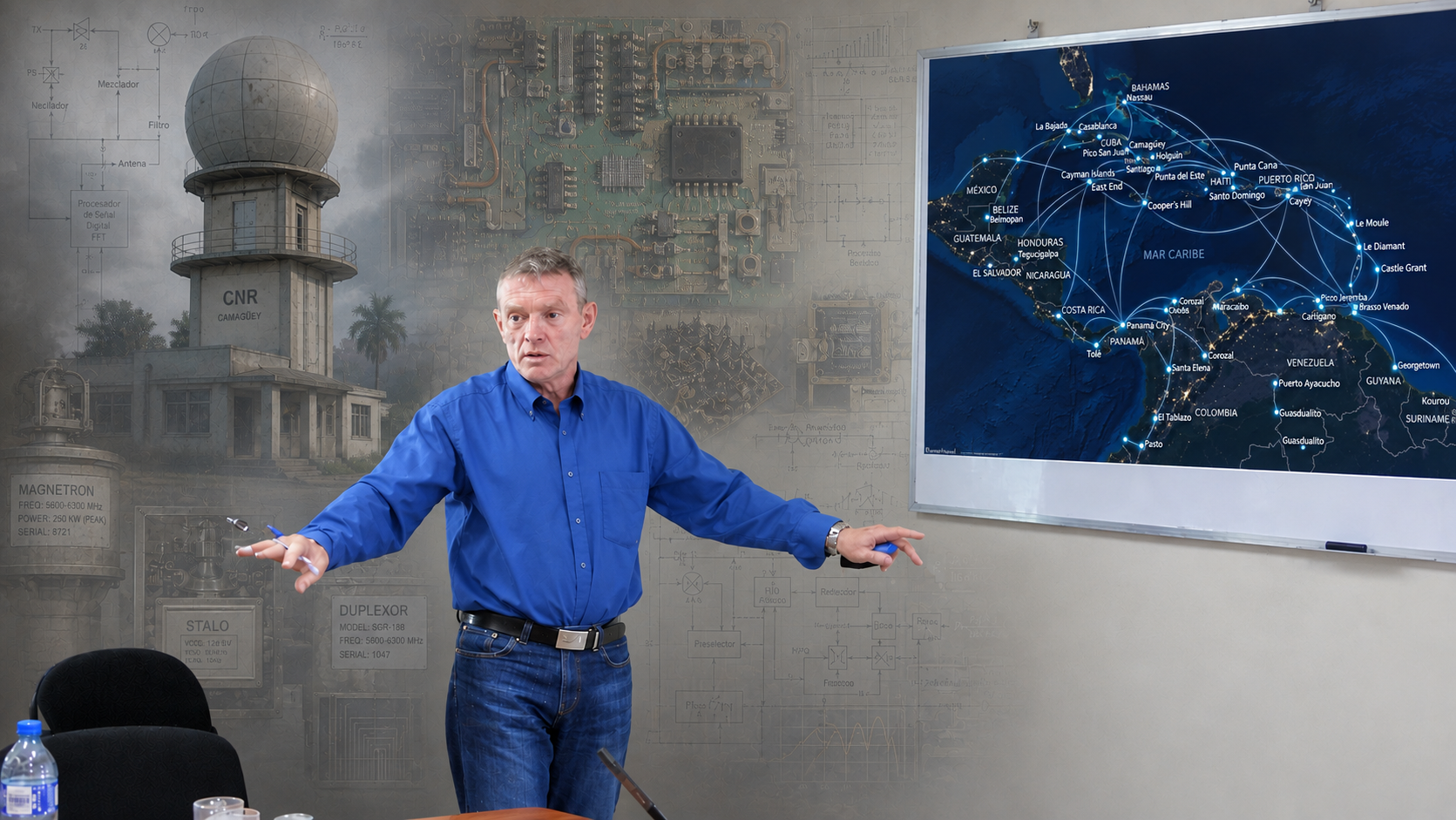
A post to talk about the possible integration of weather radars in the Caribbean. Versión en español aquí.
The Cuban zarzuela is neither opera nor comedy. It is a form of lyric theatre in which instrumental and sung music intertwines with spoken passages, and in which characters of different registers —soprano, tenor, baritone, chorus— do not sing the same thing, yet converge on a single story. Cuba is the only country in Spanish America where the genre acquired fully national character: Lecuona, Roig, Prats knew how to fold Cuban rhythm and phrasing into a polyphonic structure, and out of that came works that are at once universal theatre and a portrait of this island.
That is, precisely, the situation of the radars of the Caribbean and the Gulf of Mexico. Each radar is a voice in the score: a different manufacturer, a different wavelength, a different scanning capability. No single one of them sees the whole work. And yet, when the hurricane comes toward us, all of them ought to be singing together. Let me speak plainly, because I have been turning this over for days and can find no way to say it without bluntness: we have an orchestra that has not finished tuning.
The metaphor is not new. It dates to 2014. In May of that year, at a workshop in Bogotá, I heard Dr. Asko Huuskonen speak about the OPERA programme and its successes in spite of the diversity of technologies, scanning strategies and very different operating regimes. It occurred to me then that we, in the Caribbean, Central America and the north of South America, might manage if not an «Opera» then at least a «Zarzuela.» I wrote it on this blog and left it there, like a bottle thrown into the sea, sealed with a «perhaps someday we will manage it» that sounded more like a farewell than a forecast.
Twelve years later, the bottle has come back to shore. And it comes back with something it did not have then: an open-source conductor, capable of making voices sing together that do not even know one another. I still have no one to send it to. So I am publishing it again. If anyone at the WMO, at the CMO, or at any meteorological service in the basin reads this, let them know it is not an idea fresh off the stove: it is an idea that has been afloat for twelve years.
What we have: an orchestra of disparate voices
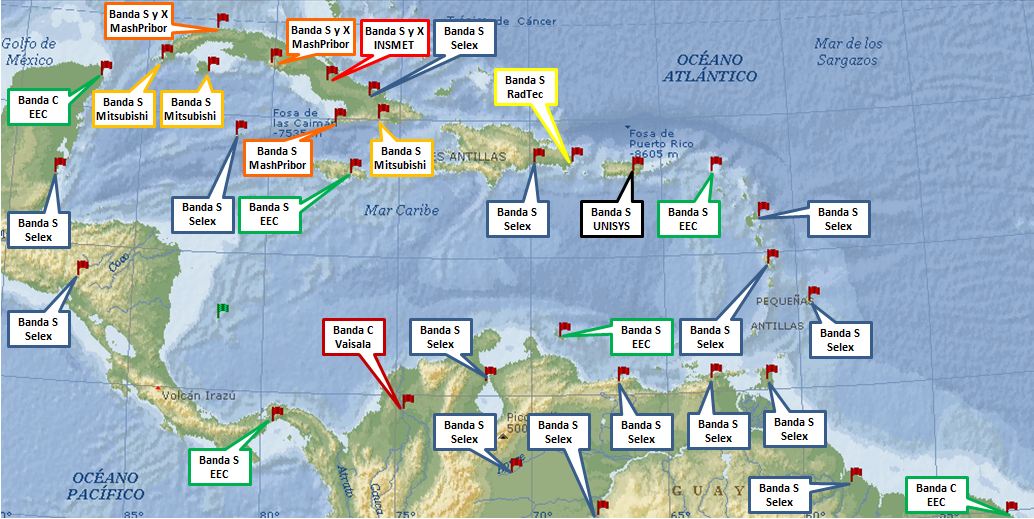
The radar network of our basin is not homogeneous, and it is worth saying so without euphemism. Three manufacturers dominate.
Leonardo Germany, heir to Gematronik and Selex, is the majority supplier to the network of the Caribbean Meteorological Organization. Its S-band Doppler radars equip Barbados, Belize, Guyana, Trinidad, the Cayman Islands, Guadeloupe and Martinique. Barbados carried out an upgrade to dual polarisation that allows it to distinguish hydrometeor types and improve rainfall estimation.
EEC supplied Jamaica’s Defender S850 radar —an S-band Doppler with dual polarisation that replaced an older-generation Doppler— as well as radars to Mexico and French Guiana.
Vaisala is present in the non-CMO insular Caribbean. The Dominican Republic operates a national network with Vaisala technology, including the solid-state WRS300 model; Curaçao operates a WRM 200; and San Andrés, in the Colombian Caribbean, also operates Vaisala equipment.
To these we must add the Cuban radars, which are a case apart. Cuba operates eight radars: four Electromash MRL-5 units of Soviet origin, three Mitsubishi RC-32B units of Japanese origin, and one modern German SELEX METEOR-1500S, all modernised through the Centre for Radar’s own development. Three of them, the RC-32Bs, are the oldest extreme of the orchestra: radars from 1973 that are still operating. At the other extreme, the Jamaican radar is the most recent in the region. Between the two, a range of intermediate states: units not yet Doppler, conventional Doppler, and Doppler polarimetric.
As for wavelengths, most operate in S-band, the natural choice for the Caribbean because attenuation by heavy rain is lower than in C or X. Some Mexican and Dominican radars operate in C-band, and there are X-band installations in Tobago and Saint Lucia, with reduced range but high spatial resolution.
Capabilities are not uniform either. There are non-Doppler, Doppler and dual-pol Doppler. That gradation is not a defect; it is reality. And it is exactly what makes integration a genuine technical problem rather than an armchair whim — made harder still by the fact that each radar scans with its own strategy, its own cycle, its own rhythm.
The mosaic that already exists, and what it does not give us
The mosaic produced by the Barbados Meteorological Service is, today, the most advanced attempt to make these voices sing together. Every fifteen minutes, that mosaic integrates data from multiple sources. In its early days it drew on nine regional radars; today it has grown to include radars from Tobago, Saint Lucia, the Dominican Republic and Cuba, reaching a maximum of eighteen contributors, including radars from Miami, Colombia and Suriname.
Its importance is not merely visual. The National Hurricane Center in Miami uses it, and NOAA has shown interest in assimilating these data into a high-resolution numerical prediction model for the Caribbean. In other words: the zarzuela is already being heard by the great orchestras of forecasting.
But there is a structural limit worth facing squarely. That mosaic exchanges already-processed images —CAPPI products in BUFR format, sometimes netCDF— not raw volumes of reflectivity and radial velocity. The coordination is therefore superficial: the visual result is shared, not the analytical raw material. Latency between radars is unavoidable, quality is heterogeneous, and assimilation into numerical models remains limited to what the image allows. We share the finished painting, not the pigments.
And there is no small detail: that mosaic is not the subject of any formal long-term arrangement. It is an initiative sustained by the goodwill of the Barbados meteorological service and by regional necessity. That is a great deal, and it deserves recognition. But it is not enough.
The European precedent: OPERA
There is no need to invent a format for cooperation. OPERA, the Operational Programme for the Exchange of weather Radar information, is the weather radar programme of EUMETNET, the network of European meteorological services. It was born in 1999 with a simple and ambitious mandate: to harmonise and improve the operational exchange of radar information among national services.
Before OPERA, exchange was bilateral and chaotic. Each country used its own format, developed for a specific installation, and communication links were dedicated and fragile. The COST 72 project ended up using four different formats for a single data exchange pilot alone.
OPERA’s solution was twofold. First, to develop a common information model, ODIM, which sets strict rules for encoding radar data and their metadata in standard formats. Second, to build a centralised data hub —the Odyssey Data Centre— that collects raw volume data from member radars and performs quality control centrally.
The advantages are precisely the ones we need. It extends the national network at no additional cost, produces operational pan-European mosaics —more than 160 radars from 30 countries feed a reflectivity mosaic updated every five minutes at one-kilometre resolution— and demonstrates that harmonisation is possible without homogenising the equipment. OPERA has succeeded in spite of the diversity of technologies, scanning strategies and calibration methods.
The difference is that Europe built its own standard. We do not need to invent anything: we can adopt one that already exists and is proven. NEXRAD Level 2, the standard of the US network, converted from each radar’s native data.
LAMULA™ ORPG: the conductor that does not care about the manufacturer
LAMULA™ ORPG is a free and open implementation of the NEXRAD Open Radar Product Generator, developed by LADETEC in Cuba. Its function is the secondary processing of raw data from any conventional weather radar, transforming volumetric information in the rough into visual and analytical products.
Its key innovation is that it removes the dependence on polarimetric variables in the quality control module, which makes it compatible with non-polarimetric radars, conventional Doppler radars and modern polarimetric radars, regardless of manufacturer. It runs on free Linux and is open source. Each radar needs an ORPG instance; the database and web server can be shared across the whole network.
In a market dominated by closed, proprietary ecosystems —Leonardo’s Rainbow, EEC’s EDGE, Vaisala’s IRIS— this returns the power of analysis to the local expert and removes the manufacturers’ black boxes. We are not asking anyone to change their radar. Not Barbados to abandon its Leonardo, nor Jamaica its EEC, nor Santo Domingo its Vaisala, nor Cuba its old Mitsubishi units from 1973. We ask only that we speak a common language at the end of the road.
To this we add LAMULA™ WebViewer, which closes the cycle: processing, standardised products, mosaic generation and open-source visualisation, without a single proprietary licence in the chain.
This is what did not exist in 2014: back then the Zarzuela was a metaphor without a score.
The architecture, in three stages
First stage: compressed transmission. Today, Cuba’s eight radars transmit their primary data in the proprietary OBS format to two centres: Camagüey as the primary, Havana as a hot backup. That format, designed by LADETEC, carries numerous variables —among them the variance of power values— and is optimised for limited bandwidth conditions. The proposal is to extend the model: each radar in the basin transmits its primary data in an equally compact format —LAMULA™ OBS or its equivalent— to one or two regional centres. Barbados, with its dual-pol radar and its experience generating the mosaic, is a natural candidate for one of those nodes. A second centre could be located in Camagüey, creating a hot redundancy that guarantees operational continuity. Transmitting compressed raw data, rather than already-processed images, preserves the full volumetric information and makes assimilation into numerical models possible.
Second stage: normalised processing. At each regional centre, one LAMULA™ ORPG instance would run per radar. The Barbados centre would have its own instance processing the Barbados radar data, another processing Trinidad’s, another Guyana’s, and so on. LAMULA™’s RDA_Back_End reads files in native format and translates them into the messages the NEXRAD ORPG requires. The result is that each radar, regardless of origin, produces Level 3 products in the NEXRAD standard: reflectivity, velocity, spectrum width, VIL, and where the hardware allows, polarimetric products. The diversity of voices has been translated into a common score.
Third stage: standardised mosaic. From those Level 3 products, a mosaic generator would be fed that integrates not only reflectivity but also radial velocity, spectrum width and polarimetric variables where they exist. The mosaic ceases to be a visualisation tool and becomes a data source assimilable into numerical models. The National Hurricane Center could ingest not only reflectivity but also the wind fields derived from radial velocity, improving the initialisation of track and intensity models. This is exactly the model OPERA validated in Europe: its data centre ingests raw volumes, not images, and produces mosaics from them.
What this proposal solves, and what it does not
It solves the interoperability of raw data, because today images are exchanged and not complete volumes. It solves dependence on a single manufacturer, because an open-source ORPG breaks technological lock-in. It solves assimilation into regional models, because the NHC and forecasting centres could ingest Level 2 data from the entire basin, not only from US radars. And it solves real integration, not merely visual: I am not proposing a prettier mosaic, but a network in which every voice contributes normalised raw data.
It does not solve hardware calibration. A miscalibrated radar keeps sending miscalibrated data, even in NEXRAD format. It does not solve physical maintenance: some CMO radars are more than a decade old and may require replacement of certain components. It does not solve connectivity: if a radar has no stable link, no software can ingest what does not arrive. And it does not solve political will or financing. Adopting a common standard implies multilateral agreements, integration budgets and training. The software is free; the engineering and the diplomacy are not.
Closing: from zarzuela to symphony
A zarzuela does not require every character to have the same register; it requires a common libretto and a conductor who knows when each voice enters. The Caribbean radar network already has the libretto —the Barbados mosaic— and already has the voices. What is missing is the shared score that turns disparate images into assimilable data, and that allows the forecast of a hurricane approaching Barbados to benefit from what Trinidad’s radar saw, from what Cuba’s saw, and from what Jamaica’s will see as the system continues on its path.
Twelve years ago I closed that entry with a «perhaps someday we will manage it.» Today I would rather close this one with a question: if the software already exists, if the European precedent is already proven, if the infrastructure is already in place and if the mosaic is already generated every fifteen minutes, what exactly are we missing?
Hurricanes do not ask for a passport or a visa to cross our waters. It seems to me an elementary matter of justice that our data should not ask for one either.
If anyone at the WMO, at the CMO, or at any meteorological service in the basin reads this and finds it reasonable, let them say so. This bottle has been at sea for twelve years. It is high time someone opened it. —Or so I say.
- Proyecto Zarzuela
- Los datos de radar, una verdadera Torre de Babel
- Más allá del formato: el desafío de la interoperabilidad
- Radares Meteorológicos al Sur del Río Bravo: Un Mapa Desconcertante
- LAMULA™ WebViewer: La Ventana Abierta a tus Datos de Radar
- Uncalibrated Weather Radars: Are We Measuring Blind?
- LAMULA™ ORPG: Soberanía Tecnológica en Procesamiento de Radar
- LAMULA™ORPG: catálogo de productos (Builds 19 a 24)
- VESTA|Process, el genial pintor de las imágenes de radar
 Hace unos días, justo el 29 de mayo, participaba yo en un Taller sobre radares en Bogotá. Me antecedió en mi presentación sobre las experiencias cubanas, el colega