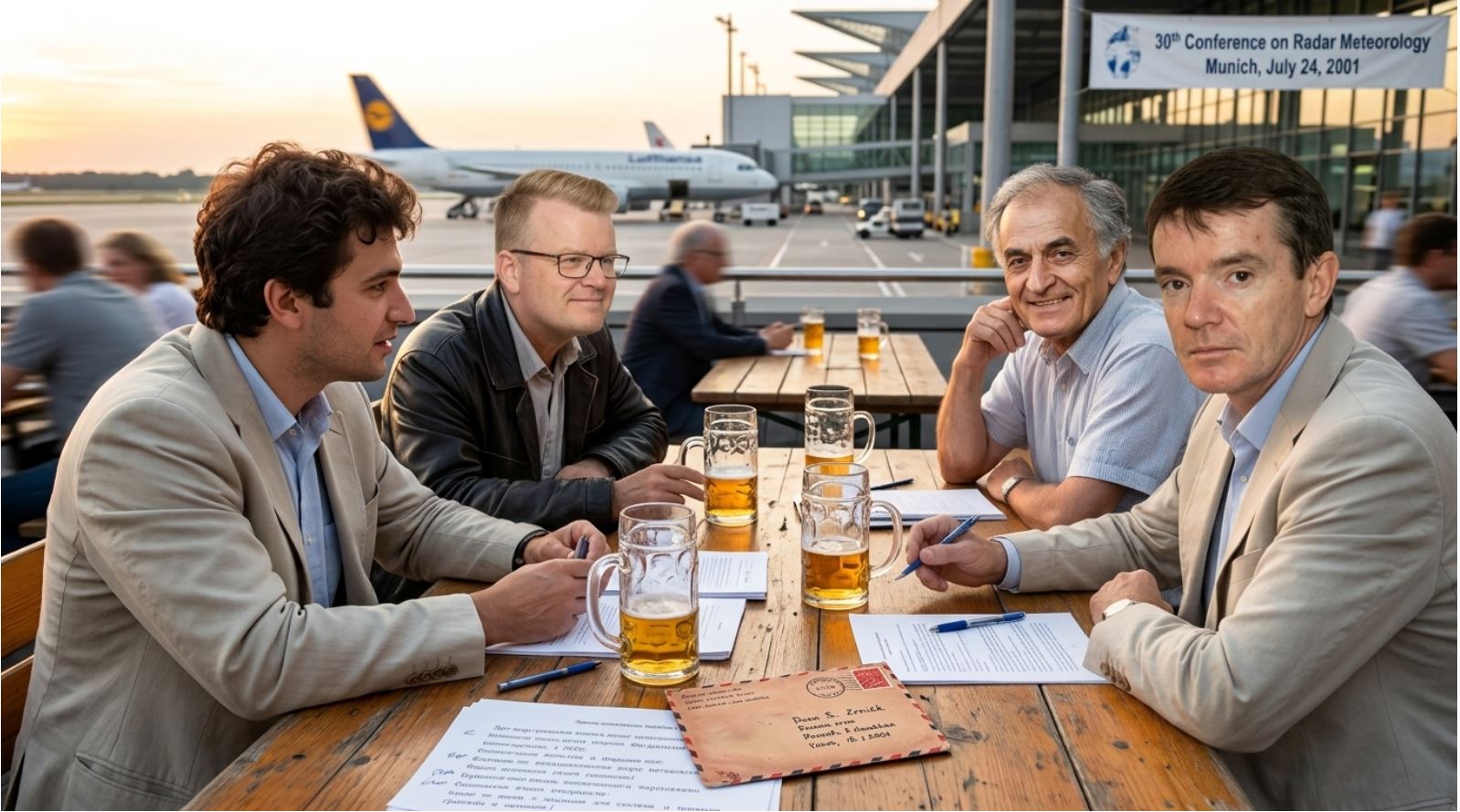
English version below. Era el 24 de julio del año 2001, una agradable y cálida tarde de Munich en que terminaba la 30ma Conferencia de Meteorología de Radar auspiciada por la American Meteorological Society (de la cual yo era miembro desde la 29na Conferencia cuando con tremendo dolor de mi bolsillo pagué la cuota de inscripción en 1999). Verdaderamente no sé cómo mi cerebro no había explotado (lea mi post Simbad y los caballeros teutones para que entienda). El caso es que al terminar el acto de despedida en el Forum Hotel de Munich, los repesentantes de Gematronik nos reunieron en el lobby a los iríamos a la visita a la fábrica en Neuss, un pueblito muy cerca de Dusseldorff y de allí partimos para el aeropuerto de Munich.
Al llegar al aeropuerto, bajamos de los omnibus y en el mismo tropel que veníamos fuimos a sentarnos en unas mesas en una terraza abierta, donde Gematronik nos escanciaría con una deliciosa cerveza alemana.
Lo verdaderamente surreilista es que en el orden en que veníamos a mí me tocó sentarme con Dušan S. Zrnić,Timo Puhakka y un joven a todas luces eslavo.
Tal vez los nombres a mi lector no les digan nada; pero para mí era como un regalo de Dios. Ellos en persona no me conocían; pero yo los había martirizado a los dos pidiéndole artículos, haciendole preguntas. A Zrnić, bueno, qué decir, sus artículos (y no menciono el libro porque no lo tuve hasta varios años después) fueron la base de mi tesis de doctorado. Con Puhakka (antes de mí ya Juan Carlos Antuña lo había martirizado), el finlandés de la Universidad de Helsinki, eran los temas de estimación de las precipitaciones. Cuando me presenté, pues cómo no, claro que sabían quien era, la pirpitilla que no se cansaba de mandar cartas (de sobre, sello y papel, sí, de las que demoraban tres meses para allá y tres mesas para acá) con preguntas y solicitudes de fotocopias (El método «epistolar» para romper el bloqueo).
En eso estábamos, yo agradeciendo y ellos (oooh, mira quien era el jodedor), cuando el joven me habla y se presenta que era del Observatorio Aerológico Central y entonces tuvimos un breve intercambio sobre mis amigos soviéticos que habían trabajado en Cuba. Noté que le costaba trabajo en inglés, entonces cortesmente le pregunto a Puhakka y a Zrnić si no les importaría que yo hablara en ruso con el hombre.
Ah, aquí viene lo sorprendente, Zrnić me dice en un ruso perfecto —Orlando, yo nací en Belgrado, Yugoslavia, hablo ruso como un nativo. Más sorprendentemente aun, Puhakka el finlandés, también en un ruso clásico nos dice —tranquilos, yo también hablo en ruso sin problemas. Así pues seguimos la conversación en ruso.
Pero hay más serendipias. En el 2018 vino a La Habana una delegación rusa de ROSHYDROMET y del Observatorio Aerológico Central (en Dolgoprudmyi, en las afueras de Moscú) para celebrar los 40 años del Laboratorio Conjunto Soviético Cubano para la Meteorología Tropical y el Incremento Artificial de las Precipitaciones. Yo asístía como director del Centro Nacional de Radares del Instituto de Meteorología. Mi contraparte, el jefe del servicio de radares meteorológicos, era Yuri Pavliukov, el joven que se sentó junto a Puhakka, a Zrnić y a mí.
El mundo es un pañuelo, y el de los radares … un pañuelito.
The Table of Mind-Blowing Serendipity in Munich
It was July 24, 2001, a pleasant, warm afternoon in Munich, as the 30th Conference on Radar Meteorology sponsored by the American Meteorological Society was ending (I had been a member since the 29th Conference, when, with tremendous pain to my pocket, I paid the registration fee in 1999). I truly don’t know how my brain hadn’t exploded (read my post “Sinbad and the Teutonic Knights” to understand).
The fact is that when the farewell event at the Forum Hotel in Munich ended, the Gematronik representatives gathered in the lobby those of us who would be going on the visit to the factory in Neuss, a small town very close to Düsseldorf, and from there we set off for Munich Airport.
When we arrived at the airport, we got off the buses and, in the same throng we had arrived in, went to sit at some tables on an open terrace, where Gematronik would serve us a delicious German beer.
What was truly surreal is that, in the order in which we were coming, I ended up sitting with Dušan S. Zrnić, Timo Puhakka, and a young man who was clearly Slavic.
Maybe the names mean nothing to my reader, but to me it was like a gift from God. They didn’t know me in person, but I had tormented the two of them by asking them for articles and asking them questions. As for Zrnić, well, what can I say? His articles (and I won’t mention the book, because I didn’t have it until several years later) were the basis of my doctoral thesis. With Puhakka (Juan Carlos Antuña had already tormented him before me), the Finn from the University of Helsinki, the topics were precipitation estimation. When I introduced myself, well, of course, they knew who I was: the little pest who never tired of sending letters (with envelope, stamp, and paper—yes, the kind that took three months to get there and three months to get back) with questions and requests for photocopies (the “epistolary” method for breaking the blockade).
We were in the middle of that—me thanking them and them (oh, look who the pest was)—when the young man spoke to me and introduced himself as being from the Central Aerological Observatory, and then we had a brief exchange about my Soviet friends who had worked in Cuba. I noticed he had difficulty with English, so I politely asked Puhakka and Zrnić if they would mind if I spoke Russian with the man.
Ah, here comes the surprising part: Zrnić says to me in perfect Russian—“Orlando, I was born in Belgrade, Yugoslavia; I speak Russian like a native.” Even more surprisingly, Puhakka the Finn also says to us in classical Russian—“Relax, I also speak Russian without any problem.” So we continued the conversation in Russian.
But there are more serendipities. In 2018, a Russian delegation from ROSHYDROMET and the Central Aerological Observatory (in Dolgoprudny, on the outskirts of Moscow) came to Havana to celebrate the 40th anniversary of the Joint Soviet-Cuban Laboratory for Tropical Meteorology and Artificial Enhancement of Precipitation. I was attending as director of the National Radar Center of the Institute of Meteorology. My counterpart, the head of the weather radar service, was Yuri Pavliukov, the young man who had sat next to Puhakka, Zrnić, and me.
It’s a small world, and the radar world… an even smaller one.
Deja una respuesta