Versión en español aqui.
If you are someone involved in the purchase or donation of a weather radar for a “developing” country—a very sugar-coated and euphemistic way of not saying underdeveloped—allow me to “stick my spoon in” (a Cuban saying for expressing an opinion nobody asked me for): the decisive question is not how many radars and of what types can be bought to help that country’s meteorology, but what that country will be able to keep running when the warranty expires, the supplier stops responding, the spare part does not arrive on time, the manufacturer becomes unreachable, and the budget has shrunk to a fraction of what was planned.
I do not speak about this from abstract theory, nor from a manual, nor from a conference room. I speak from forty-five years of work with radars on an archipelago that has been operating them for more than fifty years under a fierce blockade, without direct access to manufacturers, without the right to returns, and without even the possibility of asking technical questions about the spare parts that must be bought through tortuous channels—and with the obligation to get it right on the first try because there is no money for a second purchase. Here we have not learned to buy spare parts: we have learned to take each module apart in order to redesign it and build it from other components, and to keep a well-established list of options—from A to Z—to rebuild the functionality of any radar module that breaks down.
If someone is going to advise an underdeveloped country—let us set euphemisms aside, since we all know that the gap between developed and non-developed countries does nothing but widen—on acquiring technology that will have to work in that country’s real conditions, not ideal ones, I suggest looking at the Cuban experience: that of a kind of world champion in sustainability under very adverse conditions. I am not boasting; it is just that some questions can only be answered from the scars of a survivor of many battles.
Part One: The Universal Complexity of Sustaining a Radar Network
Buying spare parts for weather radars is not a trivial matter anywhere in the world, not even for the high-budget institutions I have visited. Anyone who has been close to the technical management of an atmospheric surveillance network knows it: behind every operating system there is a chain of decisions that is rarely visible, but that sustains the real operation.
The starting point is an uncomfortable reality: electronic equipment is no longer built to last forever (forget the “almendrones,” the old 1950s cars still circulating in Cuba). Industry imposed increasingly short life cycles. NOAA itself acknowledges that its NEXRAD radars, designed in the 1980s and built in the 1990s, required a nine-year, $150 million service life extension program to “eliminate obsolete elements” and update components that “had not been updated or required technological renewal.”
The World Meteorological Organization (WMO) documents that, although the theoretical service life of a radar may be fifteen to forty years, in practice equipment usually stops operating earlier due to component degradation and circuit failures.
To this is added the tension between inventory and budget. All technicians want spare parts “available at arm’s reach,” but no manager—at any level—wants to tie up money in warehouses. The WMO recommends that institutions keep up to 30% of the radar’s initial investment in critical spare parts on site, but the budgetary reality of many meteorological services—especially in developing countries—makes that recommendation more of an ideal than a practice. The spare parts strategy is debated between two extremes: buying a complete inventory and assuming the cost of parts that age on shelves, or depending on a contract—a very costly one—with the supplier so it responds quickly, and praying that delivery times are compatible with operational emergencies. In underdeveloped countries, however, long outages are the norm.
Then there is the jungle of codes. Each manufacturer identifies its products with alphanumeric nomenclatures that encode dozens of technical characteristics. To that complexity is added the fact that distributors superimpose their own commercial codes. The result is a labyrinth where human error is a sword of Damocles over whoever must prepare the lists: components change with each new series, which means new digits in the code, and one must be a true expert to order every tiny component.
Market variability makes all of the above worse. Manufacturers disappear, distributors change their portfolios, a product that was standard yesterday is discontinued today. A case study of the Zimbabwe Meteorological Services notes that the sustainability of the radar network depends to a large extent on the availability of spare parts and consumables, and that their absence translates directly into data gaps that compromise the quality of meteorological information. In the United Kingdom, a 2009 document already warned that most radars were between ten and thirty years old and that “managing the obsolescence of mechanical and electrical parts was becoming increasingly challenging.”
In short: managing radar spare parts is a permanent balancing act between the technical, the economic, and the logistical. Those who do it well sustain the operation. Those who do not accumulate silent radars that soon become museum scrap or disappear into the jungle or on some remote peak.
Part Two: When the Environment Adds Layers of Difficulty
There are contexts where that universal complexity multiplies. It is not only a matter of tight budgets—something maintenance engineers complain about everywhere, even in institutions in highly developed countries—but of structural restrictions that completely alter the equation. The manufacturer promises spare parts for ten years; but in less than five it structurally modified the receiver and transmitter, no longer has the components, and then offers you a major overhaul.
When a country faces limitations on acquiring technology directly from manufacturers or distributors, the purchasing process stops being a conventional commercial transaction and becomes an operation of ingenuity (or divination). The possibility of consulting the supplier about compatibility, verifying specifications with the manufacturer, or returning a defective part disappears. Everything must be decided with the information available, which is never very abundant.
To this is added the artificial increase in product prices. The intermediaries that agree to operate in these contexts charge risk premiums, demand advance payments, and rarely offer guarantees (and if they do, they do not honor them: they bet nothing will happen). The nominal budget is reduced in practice, and every purchase takes on a disproportionate strategic weight. The case of Cuba is extreme: buying spare parts in violation of the blockade costs us four to five times more than it would cost an institution able to buy them directly.
The response to this scenario is not resignation. It is the development of one’s own capabilities. When the complete module cannot be bought, the alternative is to learn to build it from simpler components, less subject to restrictions and more available, even at the hardware-store level. That implies mastering design, integration, software, and validation. It implies training engineers who not only maintain, but create. LADETEC, since its creation, has been a small group of engineers who repair radars and at the same time develop their own solutions to repair at lower cost and with greater speed and flexibility.
The WMO recognizes that the sustainability of a radar network requires personnel dedicated to maintenance planning, spare parts inventory management, and life-cycle management. But there are contexts where those plans must be built without the safety net of an accessible supplier. That is where homegrown engineering stops being a luxury and becomes the only guarantee of continuity. Whoever manages the purchase of components must necessarily be a radar expert who, at the same time, develops solutions. A commercial agent who knows nothing about radars will never be able to act with agility and effectiveness.
Part Three: The Incredible Cuban Experience
In Cuba, that reality is not theory. It is the daily practice of a group of engineers who have sustained a network of weather radars for decades under conditions few would consider even viable.
The island operates eight radars—seven of them with 1970s technology and one, the Holguín radar, from 2005—distributed throughout the archipelago, guaranteeing monitoring of the national territory and adjacent maritime zones. This network, managed by the Institute of Meteorology and with its national center in Camagüey, has made it possible to incorporate essential elements into the nation’s Early Warning System for more than fifty years, and its data are shared with international organizations and with the U.S. National Hurricane Center.
The U.S. economic, commercial, and financial blockade prevents access to necessary spare parts, and the complex financial situation hinders even imports that would technically be possible. A Cuban meteorology specialist has noted that the blockade “has prevented the island from buying parts and equipment on the U.S. market for local weather stations.” Manufacturers require knowing the final destination of their products, and Cuba is, of course, a prohibited destination for critical components.
Faced with that panorama, the development of homegrown capabilities was not a deliberate strategic choice at first. It was a survival response. In the early 1990s, when the Soviet MRL-5 and Japanese RC-32B radars, inherited from earlier decades, began to fail and original spare parts became unreachable, a group of engineers in Camagüey, constituted as the Technical Development Laboratory—today LADETEC, a cooperative—began to learn by doing.
The RC-32B radars, manufactured by Mitsubishi Electric Corporation, were installed in Cuba in 1973. Today, more than fifty years later, the three are still working (halted by the oil siege and the stranglehold of the U.S. government). A Cuban expert has called them “the most successful and sustainable project that UNDP and WMO have ever had.” The Revista Cubana de Meteorología described the maintenance of these systems as “an unprecedented technological feat.”
The MRL-5 radars, of Soviet manufacture, met a similar fate. A chronicler describes how this “veteran of technological war” held firm “on the basis of ingenuity and spare parts manufactured by LADETEC’s own specialists.” The modernization of these radars involved replacing the original control functions with industrial computers, a process first carried out in Camagüey in 1997 and later extended to other radars. What is truly surprising is that the modern Holguín radar, a 2005 METEOR-1500S, suffered a failure of its original control system, and it was replaced by the VESTA/RDA, just as in the old 1970s radars. The solution proved to be universal.
From that process emerged a methodology that combines maintenance, repair, and development. Every breakdown becomes a learning opportunity. Every component that fails repeatedly is a candidate for redesign. Every maintenance plan is crossed with a reliability improvement plan; that is: we replace the module with an identical one or develop our own with the same functionalities using other components. The goal is not only to repair: it is to reduce the probability that the same failure will occur again.
The culmination of that capability was building three complete Doppler weather radars—hardware and software—from elementary components, not complete blocks. LADETEC takes pride in the fact that Cuba is among fewer than ten institutions in the world (including major factories) capable of manufacturing a weather radar with 100% homegrown hardware and software. Not because it has access to cutting-edge technology, but because it has learned to build it from the foundations.
That does not mean the process is easy. Preparing spare parts lists for Cuban radars is a task that consumes weeks of specialized work. It involves reviewing codes, verifying compatibility, estimating prices without formal quotations, adjusting to the available budget, and, above all, anticipating consequences. An error in a list can mean months of delay in recovering a failed radar. The methodology that has been developed—based on failure statistics, rigorous tracking of operating hours per component, and risk management calibrated by experience—is the result of decades of practice.
The results are visible: radars that have been running for half a century, a network covering the national territory and adjacent maritime zones, data that feed the Early Warning System for hurricanes. And an advisory capacity that has been exported to ten countries, because knowledge acquired under adverse conditions has a value that transcends borders.
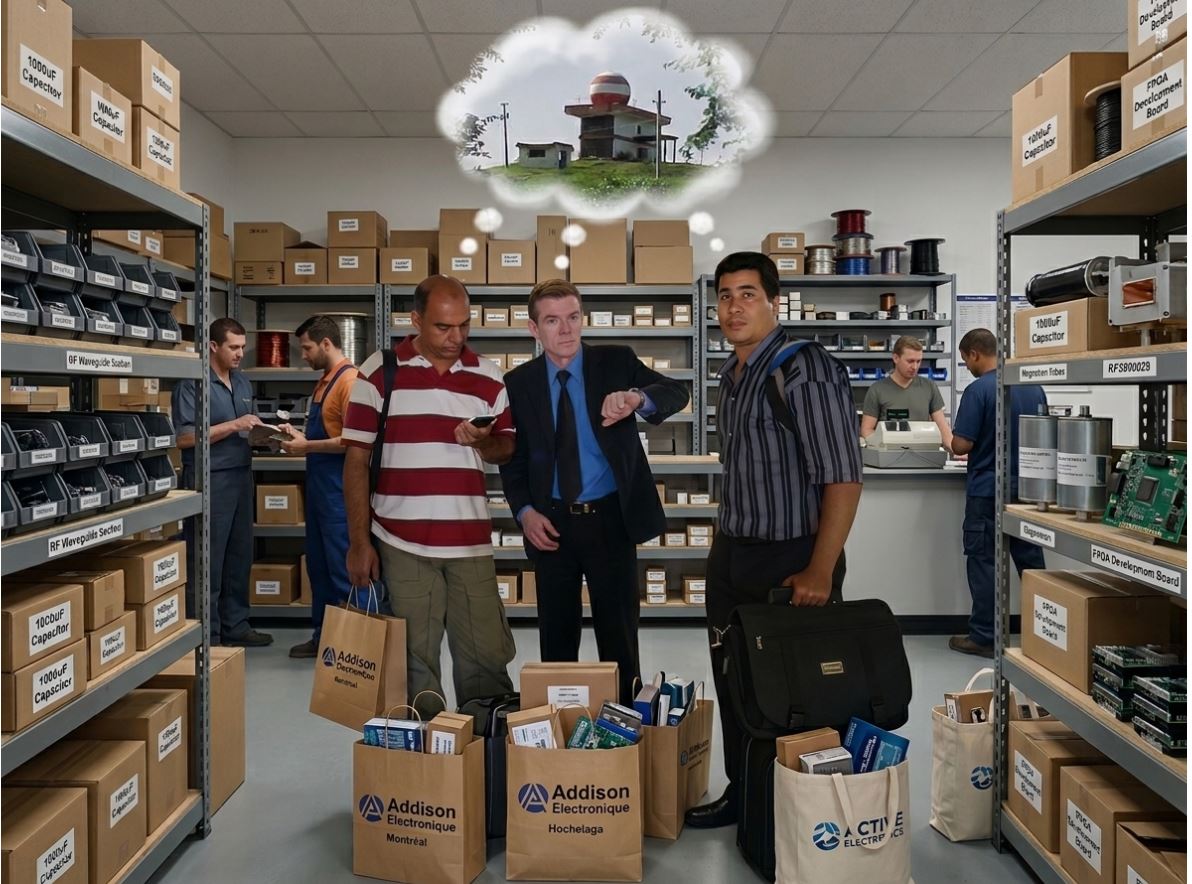
This is not about boasting. It is about stating a fact: when there is no access to the market, the only way out is knowledge. And that knowledge, once built, becomes an asset that no blockade can confiscate. Perhaps if we had been able to buy as the AI-generated image suggests, today we would have nothing to share.
Closing
I am not writing this to sell anything or to ask for anything. I am writing it because I know there are countries in the Caribbean and Latin America facing, to a greater or lesser extent, the same impossible equation: radars that are bought with effort and lost for lack of a spare part no one wants to sell them.
To those countries—to their meteorological services, their ministries, those negotiating a donation or a purchase—I say that the Cuban experience is available. We have no magic formulas or catalog solutions. We have forty-five years of learning to maintain what others would have declared lost, and we have learned that knowledge is better shared than hoarded. If what we have done here is useful to anyone, we will gladly tell them: how we plan spare parts, how we decide what to buy when the budget falls short, how we redesign a module when the original no longer exists, how we train engineers who purchase and develop at the same time. We do not offer turnkey technology. We offer something that may be worth more: the certainty that it is possible to sustain a radar network without depending on the global market taking pity on us. Cuba has done it. Others can do it. And if our scar helps someone else avoid having to open their own, it will have been worth it
Further Reading
If the subject interests you, you can consult these other posts:
Deja una respuesta